Lesson 4 - Time sensitivities of delivery promise & order fulfillment
Order fulfillment is a race against time. Every minute that passes between the moment an order is placed and the moment it is delivered affects customer satisfaction, retention, and the merchant’s reputation. Cycle time is not just a measure of operational speed — it is a measure of time sensitivity, and understanding this sensitivity is essential to meeting delivery promises.
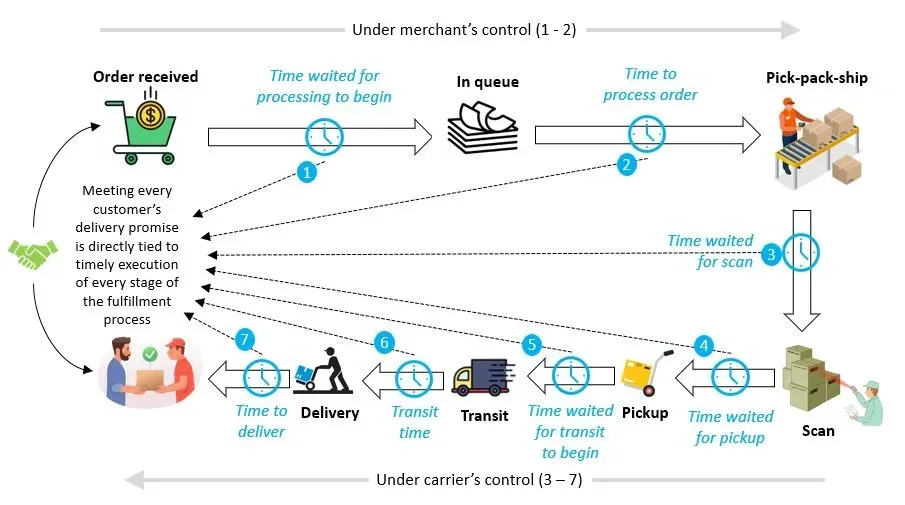
This lesson breaks down why cycle time is so time‑critical, how delays accumulate, and why merchants must monitor cycle time continuously to protect customer trust.
1. Why Cycle Time Is Time‑Sensitive
E‑commerce customers expect fast, predictable delivery. Since 2019, online shopping has accelerated dramatically, and expectations have risen with it:
- Customers expect delivery within hours or days, not weeks.
- Delays of even one day can cause customers to switch to competitors.
- 69% of customers say they are less likely to shop again if a delivery arrives more than two days late.
- 17% stop shopping after a single late delivery.
- 55% stop after two or three late deliveries.
Cycle time is the foundation of the delivery promise. If cycle time slips, the delivery promise slips — and the customer relationship slips with it.
2. The Fulfillment Process Is a Clock That Never Stops
Once an order is placed, the clock starts ticking. Every stage of the fulfillment process consumes time, and every delay compounds downstream.
The order lifecycle can be viewed as a series of time windows:
- Waiting to be processed (merchant-controlled)
- Pick–Pack–Ship (merchant-controlled)
- Carrier pickup and first scan (carrier-controlled)
- Pre‑transit movement (carrier-controlled)
- In‑transit movement (carrier-controlled)
- Out‑for‑delivery (carrier-controlled)
- Delivered
Each stage has a start timestamp, an end timestamp, and a cycle time.
Together, these cycle times form the total order fulfillment cycle time.
3. Merchant‑Controlled Time vs. Carrier‑Controlled Time
Merchant‑Controlled Stages
These stages determine the ship‑by promise:
- Order in queue
- Pick
- Pack
- Ship (label → handoff)
This is the internal cycle time — the part the merchant fully controls.
Carrier‑Controlled Stages
These stages determine the delivery promise:
- Carrier pickup
- Pre‑transit
- In‑transit
- Out‑for‑delivery
The merchant does not control these stages — but the merchant is still accountable for the customer’s experience.
Customers don’t distinguish between internal delays and carrier delays.
They only see one thing: “My order is late.”
4. How Delays Compound Across Stages
Cycle time is time‑sensitive because delays propagate.
A small delay early in the process can cause a massive delay later.
Example: A 30‑minute delay becomes a 24‑hour delay
If an order waits 30 minutes too long before processing:
- It may miss the carrier pickup window.
- Missing pickup means the package leaves the next day.
- A 30‑minute delay becomes a 24‑hour delay.
This is the compounding nature of cycle time.
5. The Domino Effect of Delays
Let’s look at how delays accumulate across the fulfillment timeline.
Scenario 1 — The Happy Path
- Orders are processed quickly.
- Pick–pack–ship is smooth.
- Carrier picks up on time.
- Transit is predictable.
- Delivery promise is met.
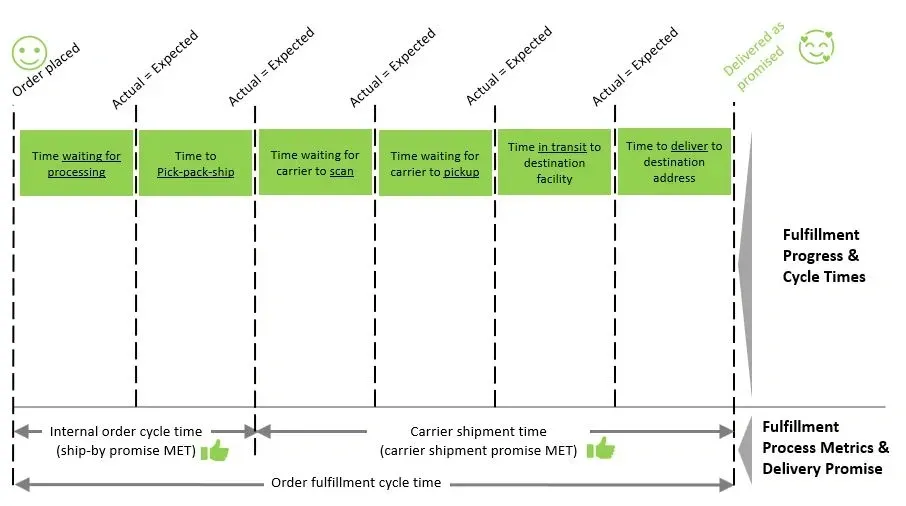
This scenario becomes the baseline for measuring performance.
Scenario 2 — Long Idle Times Before Processing
- Orders wait too long in queue.
- Staff is overloaded or unavailable.
- Weekend or holiday backlogs build up.
- A small delay early becomes a large delay later.
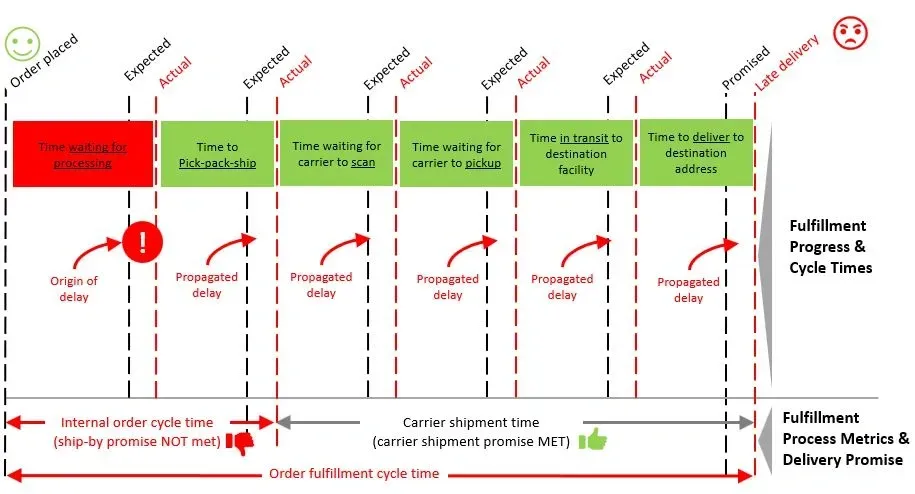
Idle time is the earliest warning sign — and the easiest to fix if detected early.
Scenario 3 — Slow Internal Processing
- Pick–pack–ship takes too long.
- Warehouse layout or bin placement is inefficient.
- Staff is walking too much or searching too often.
- Orders miss the carrier pickup window.
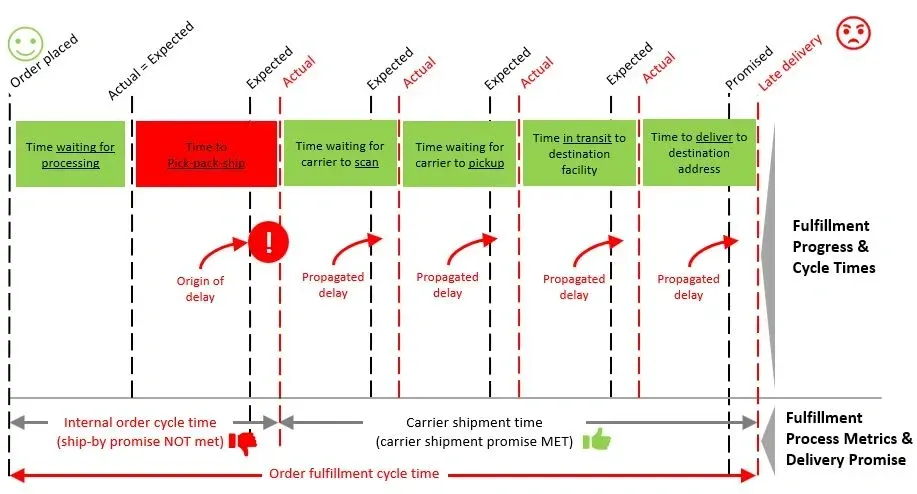
Internal delays are fully within the merchant’s control — and fully preventable.
Scenario 4 — Carrier Delays
- Packages wait too long for first scan.
- Pre‑transit movement is slow.
- Weather or routing issues delay transit.
- Out‑for‑delivery attempts fail.
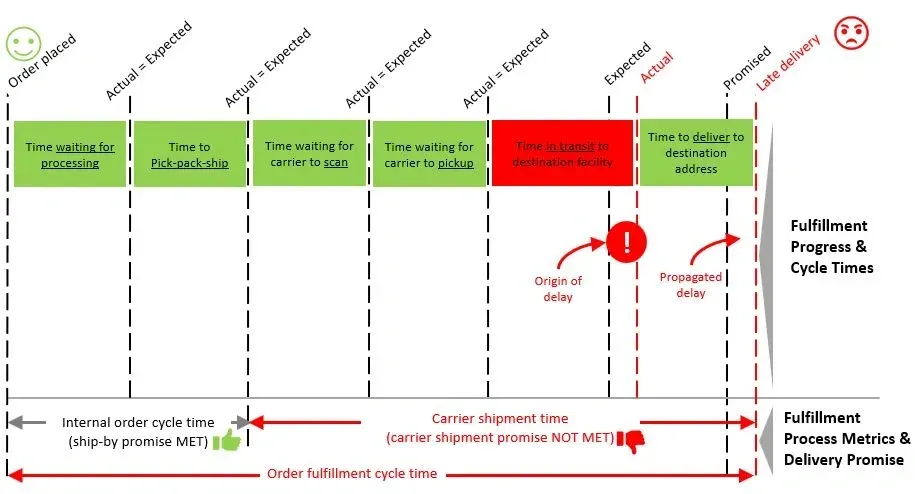
Even though the merchant doesn’t control this stage, the customer still holds the merchant responsible.
6. Delivery Promise = Ship‑By Promise + Carrier Promise
The delivery promise has two components:
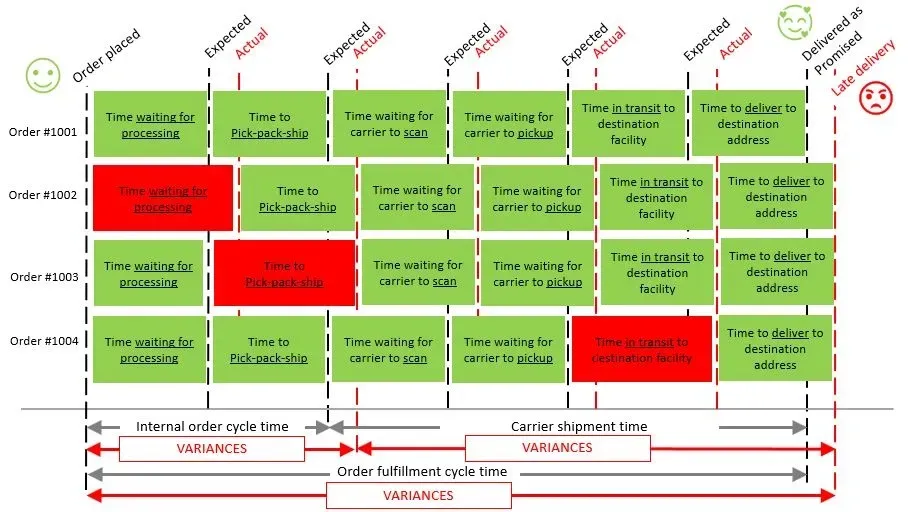
1. Ship‑By Promise (Merchant)
“How long until we ship your order?”
This depends entirely on internal cycle time.
2. Carrier Delivery Promise (Carrier)
“How long until the carrier delivers it?”
This depends on the service level (next‑day, 2‑day, ground, etc.).
If either promise is missed, the customer considers the delivery late.
7. Why Continuous Monitoring Matters
Cycle time is time‑sensitive because:
- Delays accumulate invisibly.
- Small delays become large delays.
- Internal delays amplify carrier delays.
- Delivery promises are fragile.
- Customer expectations are unforgiving.
Continuous monitoring is the only way to detect:
- rising idle times
- bottlenecks in pick–pack–ship
- missed carrier pickups
- pre‑transit slowdowns
- transit delays
- weather‑related disruptions
Without continuous monitoring, merchants are blind to the compounding effects of time.
8. FillSpeed Gives Shopify Merchants Real‑Time Time Sensitivity Awareness
Historically, only large e‑commerce companies had:
- continuous cycle‑time monitoring
- real‑time bottleneck detection
- predictive delay alerts
- end‑to‑end visibility
FillSpeed brings this capability to Shopify merchants.
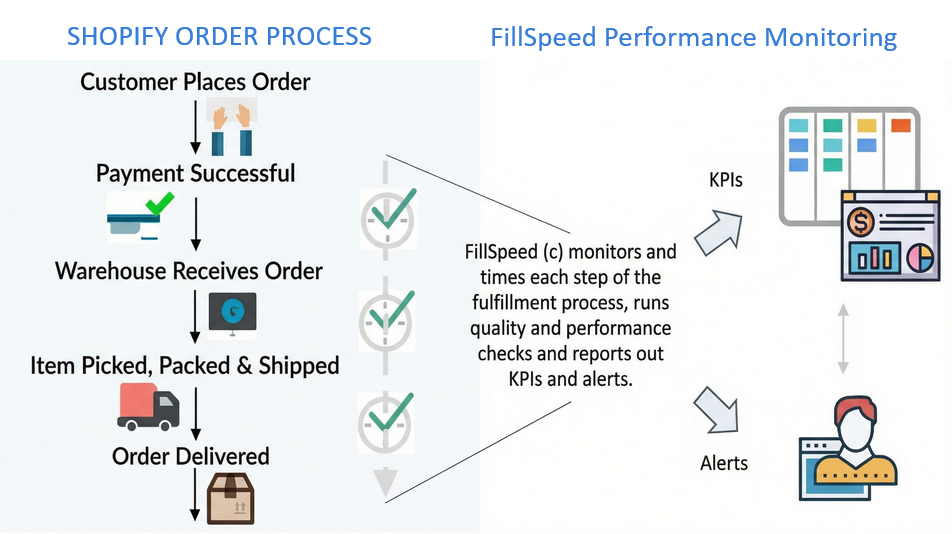
FillSpeed continuously measures:
- internal cycle time
- fulfillment cycle time
- carrier cycle time
- delivery promise performance
And it alerts merchants before delays become customer problems.
Cycle time is time‑sensitive.
Delivery promises are time‑sensitive.
Customer trust is time‑sensitive.
FillSpeed gives merchants the visibility they need to protect all three.