Lesson 3 — The Order Fulfillment Process
1. Introduction: Why We Need a Clear Fulfillment Model
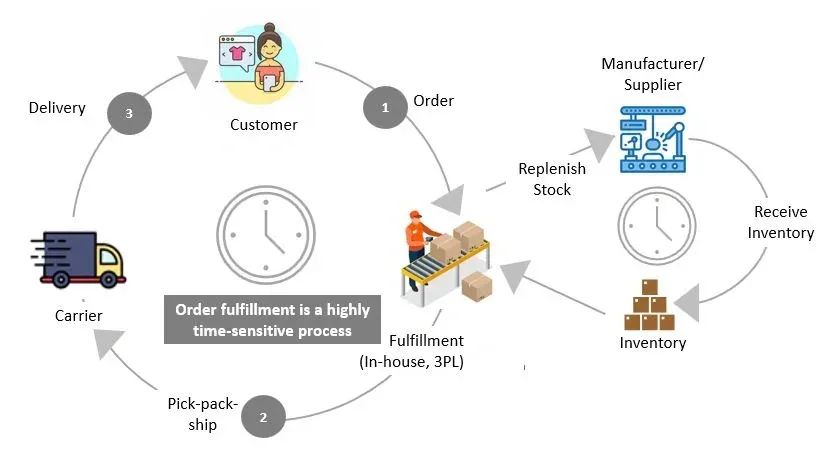
- Before we can measure cycle time or improve flow, we must understand the full journey an order takes.
- Every stage has a start event and an end event — and the time between them is the cycle time for that stage.
- This lesson maps the entire order lifecycle from payment to delivery.
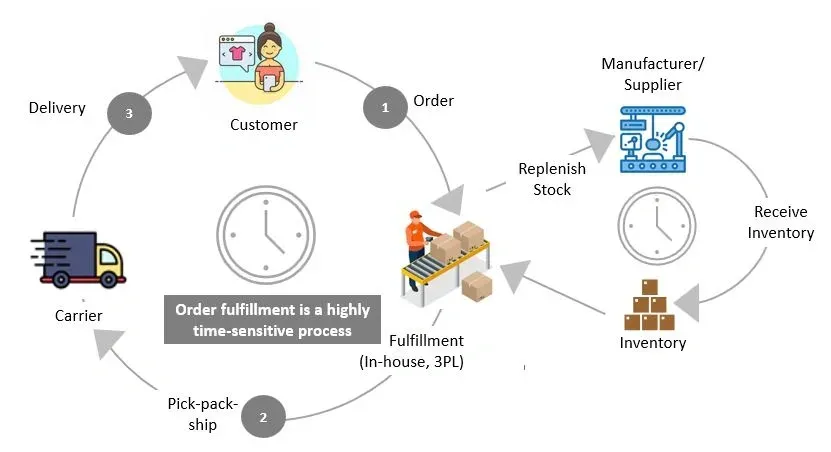
2. Stage 1 — Payment & Order Received
Start: Customer completes checkout
End: Order enters the merchant’s system (Shopify “Order Created”)
Key points:
- This is the moment the clock starts for the merchant.
- No physical work yet, but the order is now “in the system.”
3. Stage 2 — In‑Queue (Ready to Fulfill → Work Begins)
Start: Order becomes ready to fulfill
End: First physical action (usually Pick Start)
Key points:
- This is often the largest hidden delay in fulfillment.
- Represents waiting, prioritization, batching, or backlog.
- Entirely under merchant control.
4. Stage 3 — Pick
Start: Pick Start
End: Pick Complete
Key points:
- Time spent locating and retrieving items.
- A major driver of operator workload and variability.
- Errors here ripple downstream.
5. Stage 4 — Pack
Start: Pack Start
End: Pack Complete
Key points:
- Includes packaging, inserts, quality checks, and labeling prep.
- Often impacted by batching behavior and workstation constraints.
6. Stage 5 — Ship (Label → Handoff)
Start: Label Printed / Ship Start
End: Carrier Pickup Scan
Key points:
- Final internal step before the order leaves the merchant’s control.
- Includes staging, sorting, and preparing for carrier pickup.
7. Stage 6 — Carrier Pre‑Transit
Start: Carrier Pickup Scan
End: First Carrier Movement Scan (Pre‑Transit → In‑Transit)
Key points:
- The order has left the merchant but has not yet begun moving.
- Often a source of customer anxiety (“Why hasn’t my package moved?”).
- Merchant doesn’t control this, but customers still blame the merchant.
8. Stage 7 — In‑Transit
Start: First movement scan
End: Out‑for‑Delivery scan
Key points:
- Carrier-controlled transportation time.
- Weather, routing, and logistics affect this stage.
- Still part of the customer’s perception of merchant reliability.
9. Stage 8 — Out‑for‑Delivery
Start: Out‑for‑Delivery scan
End: Delivered scan
Key points:
- Final carrier stage.
- Shortest but most emotionally charged for customers.
- Delivery failures reflect directly on the merchant.
10. Stage 9 — Delivered
Start: Delivered scan
End: Customer receives the package
Key points:
- The end of the fulfillment lifecycle.
- The beginning of the customer’s post‑purchase experience.
- Sets the tone for reviews, returns, and repeat purchases.
11. Internal vs. External Cycle Times
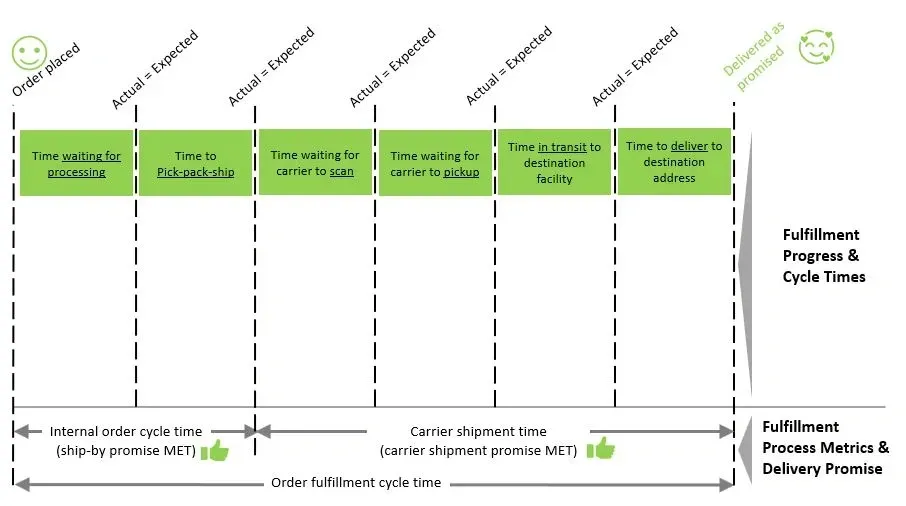
Merchant‑Controlled Stages
From Order Received → Carrier Pickup
Includes:
- In‑Queue
- Pick
- Pack
- Ship
This is the internal processing time — the part the merchant directly controls.
Carrier‑Controlled Stages
From Carrier Pickup → Delivered
Includes:
- Pre‑Transit
- In‑Transit
- Out‑for‑Delivery
The merchant does not control these times — but the merchant is still accountable for the customer’s experience.
12. Why This Distinction Matters
- Customers don’t care who caused the delay — they only care that the order is late.
- Negative reviews rarely say “the carrier was slow”; they say “the merchant shipped late.”
- Merchants must manage the entire end‑to‑end process, even if they only control half of it.
- Internal delays amplify external delays.
- Fast internal cycle time gives merchants buffer against carrier variability.
13. Every Stage Has a Cycle Time
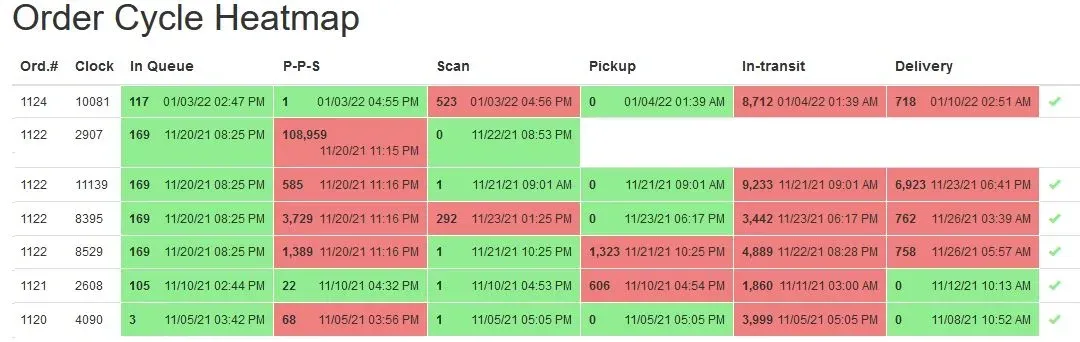
For each stage:
Cycle Time = End Timestamp – Start Timestamp
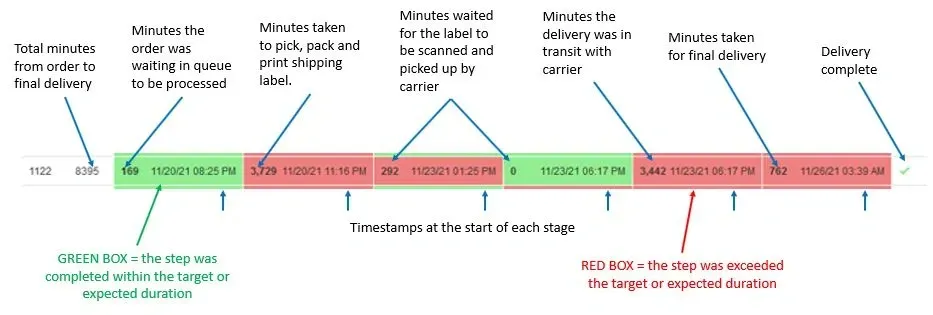
This creates:
- In‑Queue Cycle Time
- Pick Cycle Time
- Pack Cycle Time
- Ship Cycle Time
- Pre‑Transit Cycle Time
- In‑Transit Cycle Time
- Out‑for‑Delivery Cycle Time
- Total Order Cycle Time
These stage‑level cycle times are the building blocks of flow intelligence.
14. Why This Lesson Matters
This lesson sets the foundation for:
- Cumulative averages
- CAR (Cumulative Average Ratio)
- Scatter plots
- Cumulative flow diagrams
- Fulfillment KPIs (OTIF, DOT, DIF)
- Understanding where delays originate
- Distinguishing internal vs. external performance
- Improving the parts of the process the merchant controls
You cannot improve what you cannot see.
And you cannot see what you do not measure.
Lesson 3 gives merchants the full map of the journey — so the next lessons can show them how to measure and improve it.